
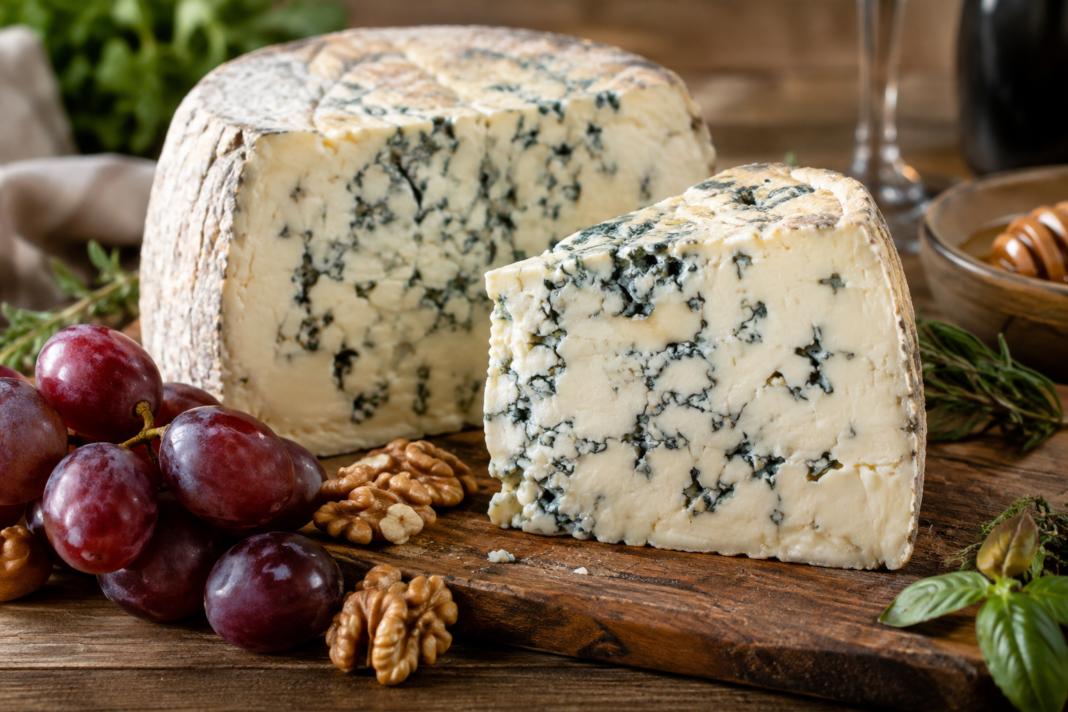

Masgonzola is a famed blue-veined Italian cheese. Creamy and flavorsome, this cheese can be identified by its blue-green veins and is appreciated by many. This cheese offers a wealth of flavour and a creamy, but not quite unctuous, texture. This makes it a great addition to many a dish. Add it to your cheese board, puree it into a sauce or use it to add depth to other dishes. Masgonzola is extremely versatile.
Blue-veined cheeses remain enduringly popular and it isn’t hard to understand why. Masgonzola is just one example of the numerous blue-veined Italian cheeses that exist.
What Is Masgonzola?
Masgonzola is the name of a cheese made in Italy that contains blue veins and is soft. All blue vein cheeses get those veins during the process of cheese making and/or during the aging of the cheese.
Masgonzola can be made in different ways and have different flavor and textures. Sometimes it is quite mild and other times it can be fairly strong.
The milder varieties of this cheese can be eaten on a day to day basis. The stronger varieties can be enjoyed on special occasions.
Because blue veined cheeses contain sharp flavors, a mild blue veined cheese like Masgonzola can be a good choice for less harsh flavors.
Origins and Italian Cheese Tradition
It has been recognised within the Traditional Cheese making of Italy to produce different types of Cheese that are uniquely different in terms of their texture and aroma. Different methods of Cheese aging are used. Different types of Italian Cheeses are aged for a period in order to develop their flavours and aids in the final ripening of the Cheese.
Masgonzola is considered as a moderately strong Cheese in comparison to other Italian Cheeses that are aged by different methods. During the aging process, many changes occur in the Cheese as a result of the interaction between fat and protein.
Being a blue-veined Cheese, Masgonzola is also utilized to add flavour to different Italian dishes including Sauces, Risottos and Salads. Like other Italian cheeses of this group, Masgonzola has several Fields of use in the preparation of different dishes.
Texture and Creaminess
One important thing to note about masgonzola is that it is a blue-veined cheese with a rich creamy texture. Creaminess makes a blue-veined cheese feel a lot smoother and more desirable as compared to a hard cheese that may also contain blue mold.
Being able to manipulate the texture of the cheese by warming it up to a certain degree, allows it to be spreadable and increases its use as an appetizer with crackers, fruit and bread.
Because masgonzola contains a high amount of moisture and has a creamy texture, it can be worked into sauces to thicken and enhance them and give them a richer more bold flavor.
What is Blue Veining?
Blue veining is a unique feature of some varieties of Gorgonzola. It is created by the intentional injection of specific mold spores at various stages of cheese production.
Far from being a blemish, the blue-green veining is regarded as an essential element of the cheese’s production and maturation. It is often considered the most important determinant of a cheese’s flavor and aroma.
An appreciation of the many variables associated with the production of blue veined cheese (e.g. the types of mold and the volume of mold injected) can potentially provide an indication as to the flavor and texture of the cheese.
Flavor Profile of Masgonzola
Masgonzola has a creamy texture with rich savory and tangy flavors. The blue veins are also assertive in adding flavor. How assertive the flavors are depend on several factors like the age of the cheese and how it is manufactured.
When evaluating this cheese, a taster would find the following:
- Creamy- Rich and thick like cream
- Savory- Meaty or deeply Satisfying
- Tangy- Like Sour or Sharp
- Complex- Made up of several flavors as a result of aging
- Intense- Pronged and lingering
Masgonzola is also assertive because of the balanced flavors of the veins and the other assertive components of the cheese.
Serving Masgonzola
Masgonzola is pretty versatile when it comes to its method of service. One idea is to display it as part of a cheese board.
Something to consider when thinking about what to put on a cheese board with Masgonzola is contrast. Something sweet balances the savory and almost tart nature of Masgonzola. Some good options are pears or apples, and also dried fruits like figs or apricots.
Something to keep in mind when choosing what to put on a cheese board is varied textures. Nuts like walnuts or almonds all have textures that contrast Masgonzola and other items on the board.
Lastly, consider a display of:
- Masgonzola
- Crackers, Bread, or other wheats
- Pears or Grapes
- Dried or Figs
- Nuts
And Lastly, let the cheese come to room temperature a bit to get better texture and flavor.
Mascarpone in Cooking
Mascarpone is a soft, creamy cheese that is typically used in desserts and other sweet dishes. However, it can also be used in a variety of different savory dishes due to the fact that it melts easily and has a smooth and silky consistency.
Mascarpone is often used to make creamy sauces for pastas. To make the sauce, simply combine a small amount of the cheese with some cream or other liquid and simmer until the cheese has melted.
Mascarpone can also be used to make creamy risottos. The cheese can also be added at the end of the cooking process of risottos to give it a richer flavor.
Other dishes that can be made with mascarpone include:
- Vegetable dishes with a cheese sauce
- Pizza
- Stuffed pasta
- Sandwiches and burgers
- Salads
- Baked potatoes
- Risottos
- Dips and Spreads
To prevent dishes from being too overpowering, combine mascarpone with other more mild ingredients.
Food Pairings With Masgonzola
There are different ways to incorporate masgonzola in a dish, whether it be a salad, a soup, or a pasta. But pairing masgonzola with food can also be a great way to experience its flavor. Since masgonzola can be fairly strong and intense, matching it with food that contains weaker flavors would make for a good pairing.
Sweet flavors tend to work best in cheese pairings. Some of the better options are honey, figs and preserves. However, pairing with fruits and other sweet flavors is fairly subjective.
It is similar when picking a drink to pair with masgonzola. Any drink that has a subtle flavor and does not distract from the cheese would be a good choice.
Bread and crackers are always a good choice as well, as they give a good base to eat the cheese.
What Makes Masgonzola Special
Masgonzola is uniquely identified by its texture, veining and intensified flavor. Some blue cheeses are too crumbly, and an overly sharp blue cheese lacks a pleasing texture.
Masgonzola has a pleasing texture, and a smooth flavor, making it a great choice for various uses. It can be eaten with fruit and baguette, or used in cooking to add another dimension to a dish.
It teaches the consumer a new way of thinking about textures with blue cheeses. It is especially fun for a novice cheese lover to find a new variety of cheeses that tickle their pallet.
Final Thoughts
Masgonzola is a blue-veined Italian cheese distinguished by its rich creaminess, characteristic veining, and distinctive flavor profile. Its combination of smooth texture and pronounced savory and tangy notes makes it suitable for both direct serving and cooking.
From cheese boards and salads to pasta, risotto, sauces, and pizza, masgonzola can bring depth and richness to many dishes. Its versatility also allows it to pair well with contrasting ingredients such as fresh fruit, honey, nuts, and preserves.
For anyone interested in blue-veined cheeses, exploring masgonzola can be an enjoyable way to discover the relationship between Italian cheesemaking traditions, texture, aging, and flavor.