
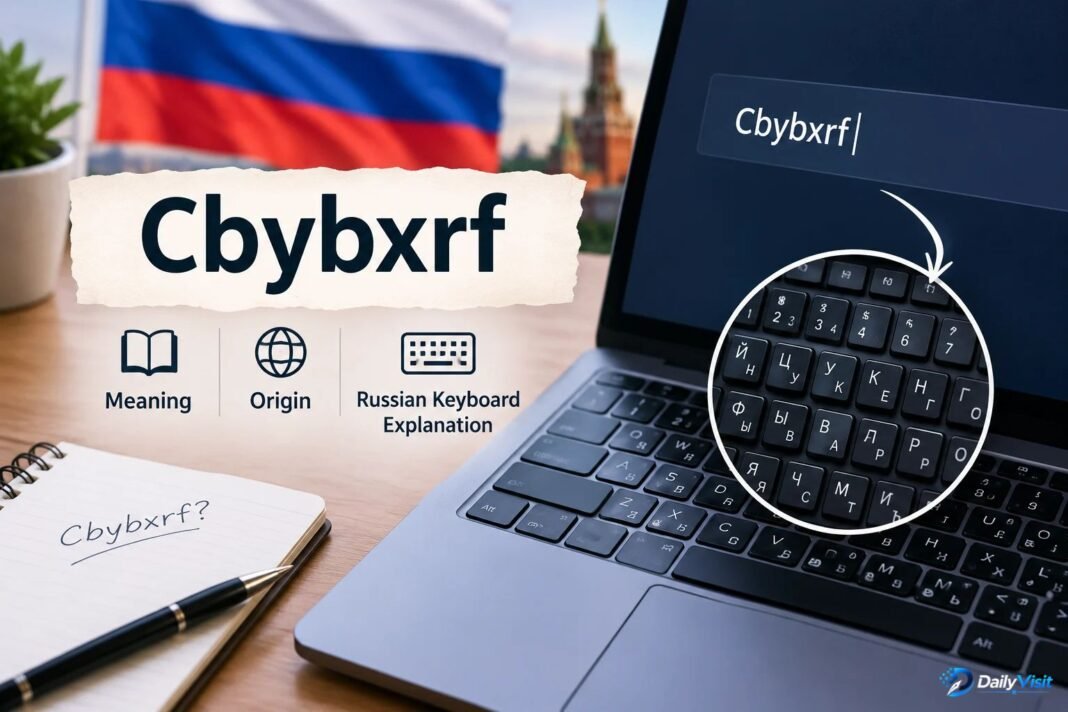

Cbybxrf is an unusual-looking digital term that can appear confusing at first glance. It does not follow the spelling patterns of a typical English word, which often leads people to search for its meaning, origin, and connection to other languages.
In many contexts, cbybxrf is understood as a digital language artifact created by a keyboard-layout mismatch. Specifically, it can occur when the Russian word “синичка” is typed while an English QWERTY keyboard layout is active instead of a Cyrillic Russian keyboard layout.
This simple keyboard issue can produce a string of Latin characters that looks meaningless to an English reader. Understanding the keyboard mapping explains why cbybxrf exists and what it represents.
What Does Cbybxrf Mean?
The keyword cbybxrf is associated with the Russian word “синичка”. The Russian term generally refers to a titmouse, a small songbird. It can also be understood in a diminutive or affectionate sense, such as “little titmouse” or “little chickadee,” depending on the translation and context.
The important point is that cbybxrf is not simply an independently formed English word. Its unusual appearance can result from typing Cyrillic characters while an English keyboard layout is selected.
This makes cbybxrf an example of how keyboard layouts can transform familiar words into strings that appear completely unrelated to their original language.
How Does the Cbybxrf Keyboard Conversion Happen?
Computer keyboards support different language layouts. An English QWERTY layout assigns Latin letters to physical keys, while a Russian Cyrillic layout assigns Cyrillic characters to many of those same physical positions.
When someone intends to type in Russian but accidentally has an English layout enabled, pressing the same physical keys can produce Latin letters instead of Cyrillic characters.
For example, a Russian speaker may intend to enter a Cyrillic word but see a sequence of English letters on the screen. To someone unfamiliar with Russian keyboard layouts, that sequence may look like a random code.
Cbybxrf belongs to this broader category of keyboard-layout artifacts.
Cbybxrf and the Russian Word “Синичка”
The connection between cbybxrf and синичка is particularly interesting because the two strings look completely different.
Синичка is written using the Cyrillic alphabet and is associated with a small bird, commonly translated as “titmouse.” The word can also carry a diminutive or affectionate meaning.
When keyboard layouts become mismatched, the intended Cyrillic characters can be represented by Latin characters based on the corresponding physical keyboard positions. As a result, an ordinary Russian word can appear online as an apparently meaningless sequence such as cbybxrf.
This is why examining the keyboard layout is often more useful than trying to find an English dictionary definition for cbybxrf.
Why Does Cbybxrf Look Like a Random Word?
The appearance of cbybxrf comes from the difference between language layouts rather than conventional English spelling.
A QWERTY keyboard is designed around Latin letters, while Russian users commonly use a Cyrillic keyboard layout. The physical keyboard can remain the same, but the characters assigned to its keys change when the operating system switches languages.
This means that a person can press the correct physical keys for a Russian word while accidentally having English selected. The computer then records Latin characters.
For an English-speaking reader, the resulting text may look like:
cbybxrf
However, for someone familiar with Russian keyboard layouts, the sequence can provide a clue about the intended Cyrillic text.
Is Cbybxrf a Russian Word?
Not exactly. Cbybxrf is better described as a Latin-character representation produced by a keyboard-layout mismatch rather than a standard Russian word.
The underlying Russian term is синичка. Therefore, when researching cbybxrf, it is useful to distinguish between the visible Latin-character string and the original Cyrillic word.
This distinction also explains why searching for cbybxrf may produce unusual results. Search engines can index the Latin sequence separately from the original Russian spelling, creating pages that discuss the term as a digital artifact.
What Does “Синичка” Mean?
The Russian word синичка is related to a small bird commonly known in English as a titmouse. The diminutive form can also communicate an affectionate or familiar sense.
Bird names can vary across languages, so translations may use slightly different English descriptions depending on context. “Titmouse” is the direct common bird-name connection, while “little chickadee” may be used as a more familiar or descriptive rendering.
Therefore, the meaning behind cbybxrf ultimately connects to a Russian word associated with a small songbird.
Why Do Keyboard Layout Errors Happen?
Keyboard-layout mistakes are common in multilingual computing environments. A user may regularly switch between English, Russian, Ukrainian, or other language layouts while writing messages, searching online, or working with documents.
A person may forget to change the active input language before typing. Instead of the expected Cyrillic text, the system produces Latin characters.
Other situations can include:
- Accidentally pressing a language-switch shortcut
- Using multiple keyboard layouts on one computer
- Switching between languages while messaging
- Copying text from different language environments
- Forgetting which input language is currently active
These situations can create strings that look like random words but actually have a linguistic explanation.
Cbybxrf as a Digital Language Artifact
One useful way to understand cbybxrf is as a digital language artifact.
Digital language artifacts are strings, spellings, or unusual forms created by the way people interact with computers, keyboards, translation systems, or online platforms. They may not resemble conventional dictionary words, yet they can have an identifiable origin.
Cbybxrf fits this idea because its appearance is connected to the interaction between:
- A Russian Cyrillic word
- A physical keyboard
- An English QWERTY layout
- A user’s intended language
- The active input-language setting
The resulting string preserves a trace of the original typing process.
How Can You Recognize a Keyboard-Layout Artifact?
If you encounter an unfamiliar string such as cbybxrf, several clues can suggest that it originated from a keyboard-layout problem.
First, the sequence may contain an unusual combination of letters that does not resemble normal English vocabulary. Second, the term may appear in discussions involving Russian or other non-Latin languages. Third, converting the characters according to another keyboard layout may reveal a recognizable word.
This approach is useful because not every unfamiliar online term is a newly invented word, acronym, company name, or technical abbreviation. Sometimes it is simply text entered with the wrong keyboard configuration.
Why Is Cbybxrf Interesting?
The term is interesting because it demonstrates how closely digital communication depends on keyboard configuration.
A person can intend to write one perfectly ordinary word, yet a different input layout can turn it into something that appears completely unrelated. Once the keyboard mapping is understood, the mystery becomes much easier to explain.
Cbybxrf therefore provides a simple example of the intersection between language, technology, keyboard layouts, and online communication.
Frequently Asked Questions About Cbybxrf
Q1. What is cbybxrf?
Cbybxrf is a digital language artifact associated with typing the Russian word синичка while an English QWERTY keyboard layout is active.
Q2. What does синичка mean?
Синичка refers to a small bird commonly translated as titmouse. Its diminutive form can also be rendered as “little titmouse” or “little chickadee,” depending on context.
Q3. Is cbybxrf an English word?
No. Cbybxrf is not generally treated as a standard English dictionary word. It is associated with a keyboard-layout mismatch involving Russian Cyrillic text.
Q4. Why does Russian text sometimes appear as English letters?
This can happen when the wrong keyboard layout is selected. The user may intend to type Cyrillic characters, but the operating system interprets the keystrokes using an English QWERTY layout.
Q5. How can I understand a strange word like cbybxrf?
Check whether it could have been produced using a different keyboard layout. Comparing the character positions between English QWERTY and Russian Cyrillic layouts can reveal the original intended text.
ALSO READ : Ksözcü: Meaning, Origin, Spelling and Connection to Sözcü
Conclusion
Cbybxrf is a useful example of how a simple keyboard-layout mismatch can create an unusual digital term. Rather than representing a conventional English word, it can be understood as a Latin-character artifact connected to the Russian Cyrillic word синичка.
The Russian term refers to a small songbird, commonly translated as titmouse, while the unusual form cbybxrf reflects the interaction between Cyrillic typing and an English QWERTY keyboard layout.
Understanding this connection makes the term much less mysterious. It also demonstrates how language and technology can interact to produce unusual spellings, search terms, and digital expressions.