
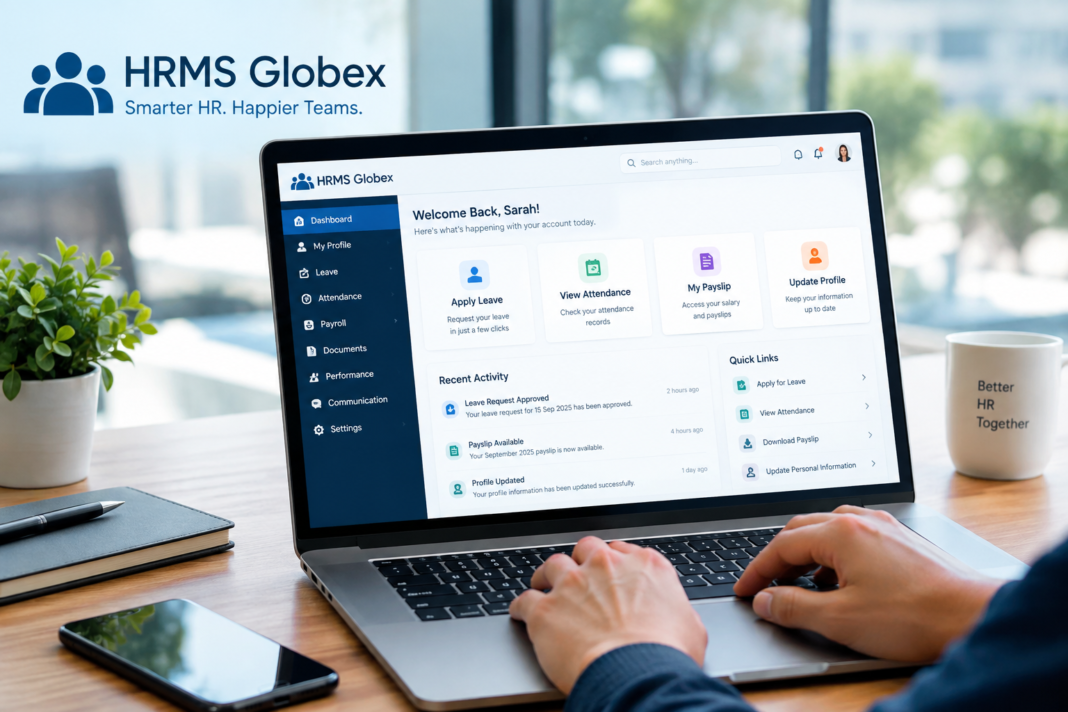

HRMS Globex provides employees the opportunity to carry out several human resource activities on their own. HR management systems allow companies to minimize the time spent by employees on administrative work. HRMS Globex simplifies the accessibility of information and services offered by HR to employees.
HRMS Globex enables companies to centralize their HR processes. A unified system enables companies to effectively manage employee information, leave, attendance, and payroll. HRMS Globex allows employees to serve themselves, thereby freeing up the time of HR employees.
Employees using HRMS Globex to access their personal information is just one example of self service. Self service can also include, but is not limited to, time off request, pay, and benefits. The main idea behind employee self service is to let employees serve themselves. Employees have traditionally relied on HR to get their work done. Self service offers numerous advantages to HR employees. HR employees no longer have to answer trivial questions. Instead, they can dedicate their time to strategic activities.
What Is HRMS Globex?
HRMS Globex is a form of HR software that assists in administering and managing employees within an organization. HR software helps organizations structure and manage their human resource information and processes in an effective and efficient manner.
A growing organization often faces challenges in administering and managing HR processes as a result of use of unproductive and time consuming ways of communicating and interacting with employees. These include use of emails, faxes, courier services, inter-office communication, and other paper based or file based information systems.
Digital systems help replace or reduce the need for interaction and administration by HR personnel. Automation can help reduce the number of HR processes that require management. This can help improve the productivity of the HR personnel.
HRMS Globex aims to bring positive change within an organization by helping to implement and maintain an organizational structure within the digital environment.
Self-Service Employees: Trends in HR Technology
With HR technology, employees can access information on their own and perform certain HR-related tasks on their own through an employee self-service portal. Employees can, for example, check their leave balance, change their personal details, view their attendance or document electronically, etc. In such cases, there is no need for the employee to approach the HR office for assistance.
There are a number of advantages of implementing self-service in HR. For the employee, it provides more control over HR processes and services. For the HR personnel, it means fewer service requests, freeing up their time to handle more complex tasks.
Self-service in HR is not a new feature; however, it is now positioned as one of the core functionalities of an HRMS. More and more organizations are deploying HRMS to manage HR processes and services and are transforming the way employees engage with the HR function. As a part of the organization’s digital employee experience, self-service in HR is a key enabler.
Centralized Employee Experience
Centralization is another key feature of HRMS Globex. Employees interact with various HR systems and services during their employment, and there is advantage in integrating these activities.
A centralized HR system allows employees to view and/or update their personal information and attendance data; check their leave balance and apply for leaves; and access other personnel information.
Employees need not access multiple systems to view information pertaining to different aspects of their employment. Centralizing personnel information gives employees better control over their HR data and helps clarify HR processes.
From the management level, an integrated HR system allows employees to access a centralized personnel database to view and/or update details pertaining to employees. The HR team can also use the system to view and/or update employee information, which is integrated and centralized.
Managing Employee Information
Employee documents are the foundation of any HR management system. Accurate and comprehensive documents help manage employees effectively and efficiently.
An automated HR Management System (HRMS) generally captures and stores employee information in an organized manner. More advanced systems enable employees to review and amend their information based on the functionality of the system.
From an administrative and record management perspective, the system should allow employees to update their information. While this can be viewed as transferring the control and responsibility of record management from the HR/Administrative department to the employees, it can relieve the administrative workload of the HR/Administrative staff from having to review and update employee records.
For control and regulatory purposes, the system should, however, have in-built control mechanisms. All fields should not be editable. The system should, however, be designed to allow employees to change and update their information.
Leave and Attendance Self-Service
Employee self-service features for leave management can be very useful.
Currently, employees often have to rely on others to process their leave requests. Emailing a manager to process a leave request is not uncommon. The email, or the manager, becomes an alternative record of the leave request.
An automated system can eliminate these processes. Leave requests can be made through the system and be managed by a leave request approver through his/her/their manager portal.
Similarly, employees can be granted access to view attendance records and identify any inaccuracies.
Naturally, employees will be able to view their past leave and attendance requests.
Managers and HR will benefit from having centralized and automated records of employee activities.
Access to Payroll Information
Payroll is another element of the employee management process. Employees request payroll information and documents regularly.
By providing secure access to payroll information on a self-service HR system, employees can view payroll information and documents on their own. This creates a situation where HR is not inundated with requests for payroll information and documents. In addition, the HR team can gain access to employee information and documents in an organized and easy to access manner.
Payroll information and documents contain personal and financial information on employees. Therefore, payroll information security is very vital. HRMS (human resource management system) service providers must improve the protection of payroll information and documents. The service providers should incorporate features to restrict access to payroll information and documents based on the level of access granted to users.
This post was generated from taplytics-moderator-components.
The Role of Communication in HR Management
HR management is almost entirely related to communication. Employees must know how to get the information they need, who to talk to if they need assistance, and how to make requests.
Communication is one of the important features of HR Management Systems (HRMS). HRMS can help organizations improve communication. HRMS can help organizations develop systems and processes that facilitate communication related to Human Resources.
There are many advantages of such a system. Employees can track the status of their requests. A HR Management System can help organizations track and document HR related activities.
Replacing some communication related to Human Resources with a system will not eliminate the need for Human Resources staff. The system can help HR staff spend less time addressing mundane and repetitive communication.
How HRMS Globex Supports Employee Empowerment
With employee self-service HR technologies, the goal is to empower employees. Providing employees immediate access to relevant information helps eliminate delays and increase overall productivity. HR technologies that facilitate and support self-service for employees simplify access to HR information and process automation. When integrated with core HR and payroll systems, employee self-service applications enable a range of activities that span from accessing and updating personal information to submitting and reviewing leave applications and accessing various HR documents.
From an employee experience management perspective, implementing self-service HR technologies to empower employees can help simplify and automate routine HR activities. This can increase overall employee engagement and drive a strong sense of ownership among employees with regard to their employment information and processes.
Benefits for HR Teams and Managers
One added benefit to employee self-service is what it can do for HR.
First, it makes HR’s job less of an administrative role. If employees can process their own forms, HR can spend less time doing administrative tasks.
Also, management can benefit from the improvement of employee leave and attendance systems. Managing these processes can be difficult when they occur throughout the entire organization, but a centralized system makes these processes simpler.
This can be especially useful for HR in developing other areas of the organization such as employees, processes, and systems.
Usability of HRMS
A comprehensive HRMS can transform the way HR teams work. However, if the system is difficult to use, it will eventually fail to meet the requirements of the business.
Self service features will not benefit the HR team if the HRMS requires complex commands to perform basic HR activities.
Features such as navigation controls, activity controls and service controls should be designed in such a way that the location of various commands are intuitively understood by the end users.
Most important of all, HR team members must be trained on the use of the new HRMS. Employees, particularly in the HR function, tend to rely on their judgment and experience when dealing with manual and repetitive processes. Therefore, training may help ease the anxiety of HR employees moving to a more structured work process.
Security and Data Privacy
Security is a major consideration for any HR system as it may include personnel records, contact details, bank details, attendance records and other personal data.
Prior to making a decision to select HRMS Globex or any similar product, the assessment of security features must be completed by the prospective customer.
Prior to implementation of an HR system, the customer must review the authentication mechanisms,user access, data access, backup and other features.
The HR system must provide a mechanism to restrict access to personal data to only employees who need such access in the course of their employment.
Restricted access to data is critical especially in HR self service systems to ensure that the self service does not compromise the privacy and security of the data.
HRMS Globex and the Future of HR
HR departments are under pressure to follow their organizations’ digital transformations by moving from on-premises to digital HR systems. This requires HR to provide more and better employee services in a more efficient and effective manner.
To meet these requirements, employee self-service (ESS) will increasingly be part of HR service delivery.
HRMS Globex is one of the first HR management systems that focuses on connected HR and provides employee and administrator self-service.
HR Automation will continue to play a more important role in HR service delivery. However, there will always be a need for HR service delivery that is supported or supplemented by HR service professionals.
To succeed, HR systems must integrate adequate levels of security and control to ensure the protection of employees’ personal and sensitive data. HR systems must also be capable of integrating with other enterprise systems. Inadequate integration limits the systems’ effectiveness and impact.
Final Thoughts
HRMS Globex illustrates the future of human resource management by providing integrated and personalized services to employees. It uses automation to help employees access their information and integrate routine administrative tasks.
With self-service options, employees can manage their information and requests, as well as access and update their personnel data, submit leave requests, and access their salary information, among other things. This also provides greater work flexibility and convenience.
HRMS Globex reflects how innovations in HR management focus on providing employees control and access to the information and services they need.
Self-service portals, when integrated with core components of an HRMS, provide a convenient and secure way for employees to manage their personnel data and HR-related requirements. As the use of digital HR solutions by organizations increases, HRMS with self-service portals are likely to be more common.