
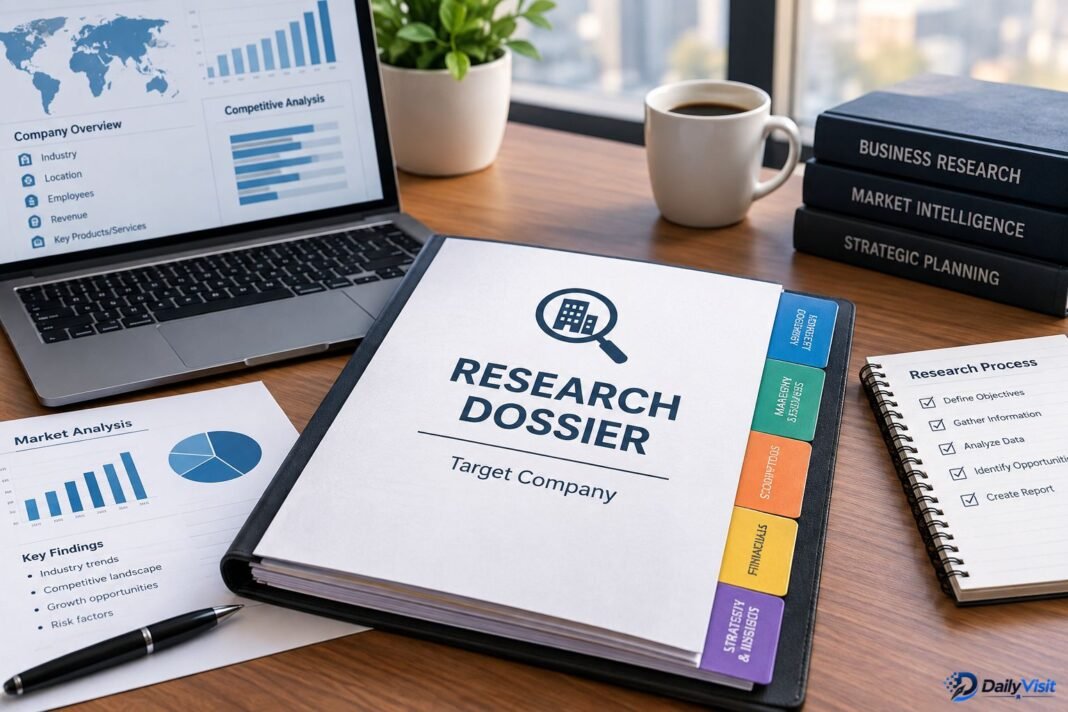

Research Dossier For Target Company! A business profile rarely provides a deep understanding of a company. If you are a marketer, investor, researcher, salesperson, student or any other person involved in business, you need easy access to information to build your own research on a business of interest.
A research dossier provides a structured format to consolidate different pieces of information about a target company. It can include company history, products/services, company’s position in the marketplace, customers, competitors, company’s web/social presence, etc.
Research Dossier Target Company, is a resource that enables you to obtain structured information about companies you want to learn more about. Instead of wasting time to find information across multiple sources, you can now use your time to evaluate information that will be useful in the business research you are doing.
What is a Research Dossier for a Target Company?
A research dossier focuses on a single target company and captures a wide range of information relevant to understanding the company and the business environment in which it operates.
Elements of a dossier may include, but are not limited to:
- Company information
- Products and services
- Customers
- Competition
- Company leadership
- Company web pages
- Company social media
- Company locations
- News and communications
- Keyword and search engine information
- Company reviews
- Other company information
Information included in a dossier depends on the objectives of the research.
The Importance of Business Research
Business research helps organize information to create relevant knowledge. Business information is often dispersed across numerous sources including company websites, news articles, financial reports, and social platforms.
Sys tematically gathering this information helps users recognize the ways in which a business interacts in a given market.
Marketing staff may wish to understand a company’s online posting and content. Sales staff may wish to understand the company’s products and the preferences of the company’s customers and competitors. Staff may wish to understand a company’s online presence and visibility.
All of the above staff members, as well as others, could benefit from a research dossier containing the information they have requested about a given company.
Sections of a Company Research Dossier
A Company Research Dossier consists of multiple sections.
1. Company Overview
The Company Overview section includes basic information about the company. Information in this section may include the company’s name and website, the industry and company location, the year the company was founded, the company’s business model and primary business activities.
This section provides a starting point for researchers and provides a foundation for more in-depth analysis.
2. Products and Services
This section includes the company’s offerings. This may include the company’s products and services, the categories of the products and services, the company’s pricing, if pricing information is available, and the company’s products’ and services’ respective target market offerings.
3. Company’s Audience
Identifying the company’s primary audience may include the company’s end-users, other businesses, individuals in the business, and/or companies in a particular industry.
This information may be documented and presented in the company’s webpages, marketing and promotional materials, case studies, and other company information.
4. Competitor Research
Understanding the competition is essential for success in business.
Study your competitors by finding publicly available information including:
- Product or Service Offerings
- Pricing
- Advertising and Marketing
- Sales Promotions
- Website Content
- Search Engine Results
- Product or Service Features
- You should also study your competitors’ positions in the marketplace.
The goal is to understand the overall competitive environment, not just list your competitors.
5. Online Presence
An analysis of a company’s online resources can provide insights into their marketing initiatives.
Websites, blogs, social media, online business directories, article/news submissions, and other business-related materials can provide information about a company’s products and/or services. Analyze the types of content provided, and the frequency of content relevant to the company.
Where a company devotes its marketing communication efforts can often be inferred from the materials provided.
Open Keyword Lists and Search Research
Open keyword lists refer to a stage in a company’s research process where they identify different keywords related to their business through Search Engine Optimization (SEO) or search intent research.
Doing keyword research allows companies to discover different expressions or phrases people use to search for or relay information related to their business.
An extensive keyword research section may include:
- Transactional keywords
- Locational keywords
- Academic keywords
- Names of different industries
- Names of different professions
- Names of different products or services
- Brand name
While researching keywords related to a project management application, it may include keywords related to workplace collaboration, employee productivity, and similar topics.
When creating keyword lists, it is essential for companies to not make involative assumptions about how consumers behave. Factors including location, search intent, and competition may change over time.
Building Your Research Dossier
Researching in a systematic way increases the chances that your dossier will be of use.
Step 1. Determining the Research Objective
You need to have a good understanding of your own research objectives. These objectives can vary from understanding your competitors as part of your sales research, to analyzing potential website visibility and accessibility as part of your SEO research, to reviewing companies as part of an industry analysis. Different objectives warrant different levels of emphasis on varying pieces of information.
Step 2. Locating Preliminary Information
Once you have a general understanding of the company, you need to look for and gather various types of company information. You should be consistent in documenting information. If you find something that is potentially important but not verifiable, you should say so. Do not present something as verified information if it is not.
Step 3. Analyzing the Offerings
Once you understand the company offerings you should look to identify the industry and/or company customers for that offering.
Look for clues on company websites in the form of ‘About Us’, product or service descriptions, case studies, and press releases.
Step 4: Research Competitors
Identify competitors and analyze their websites, products, and marketing materials.
Analysis of multiple competitors may reveal industry best practices, and may also highlight competitor shortsightedness.
Step 5: Make Keyword Lists
Make lists of keywords related to the topic under study, and include synonyms. Group these lists into related topics, like branded, service, or product terms.
Grouping keywords makes them more manageable when analyzing research data.
Step 6: Add to Your Dossier
Annotating records with headings, dates, bullet points, tables, and references make information easily accessible to the reader. Factual information should be differentiated from the analyst’s notes.
How a Target Company Research Dossier can help your Career a dossier is a flexible document.
- Sales: A dossier is a valuable resource for preparing to speak with clients and prospective clients.
- Digital marketing: A dossier can be used to research a competitor’s keyword strategy, and investigate topics covered on a competitor’s website.
- Writing: A dossier can help a writer find topics a company writes about.
- Comparison: A dossier can be used for researching competitors.
- Research: A researcher can use a dossier to fact-check or verify research findings.
- Corporate development: A company can use a dossier to research companies they do business with or wish to do business with.
Importance of Structuring Company Research
Order is the most obvious advantage of a structured dossier. Researchers may waste valuable time and energy or lose track of data if research isn’t structured.
A structured dossier allows the researcher to:
- Reduce research time
- Select and present business information
- Distinguish competitors from other companies
- Recognize and extract specific company data
- Recognize essential company information and trends
- Comprehensively compare companies
Find and recognize company and business-related keywords
Helpful Hints
Because information may be incomplete or incorrect, reliance on a single source should be avoided. Company websites are good starting points, but other sources may give more complete information.
Information may lose relevance, especially if the information describes products or people. Collecting and including the time you researched the information may help others evaluate the information.
To assist with business decisions, a dossier should contain verified information and should not contain analysis or unsubstantiated conclusions.
Frequently Asked Questions
Q1. What is a target company research dossier?
A target company research dossier is a compilation of the important information about a company. This may include the company’s history and current business information such as the company’s products and services, its clientele and competitors, as well as the company’s online business activities and keywords.
Q2. What should be included in a company research dossier?
Company research dossiers may include details concerning a company’s products, clients and competitors, as well as the leadership of the company, the company’s online presence, the business’s industry, as well as any legal and publicly available information about the company.
Q3. In what ways is the use of a research dossier beneficial in the accomplishment of business research?
A research dossier summarizes details about a company and its competitors. It may include the company’s products, clients and the company’s online activities. As a result, a research dossier may reduce the need to conduct multiple searches about a company.
Q4. What are open keyword lists?
Open keyword lists are lists of various type of company and business related words and phrases that are used in search engine optimization and company and product related research. These may include company, product and service related words and phrases.
Q5. How should I go about creating a useful research dossier for a company?
First, you should determine the reason for your research about the company. Next, you should collect and study the company’s products, clients and competitors. You should analyze the company’s related keywords and create sections based on your research findings. You should routinely update the research dossier.
ALSO READ : Capabilisense Platform: Features, Benefits, Uses and Everything You Need to Know
Final Thoughts
An in-depth analysis of a given company is helpful when evaluating new business opportunities. Unlike haphazard notes, a research dossier captures the information needed to assess a company. A research dossier should capture a company’s products and services, the company’s competitors, potential customers, a company’s online presence, and the keywords a company uses to describe its products and services.
Research Dossier, Target Company contains the aforementioned information and is very useful for the busy professional who does not have time to gather and organize information. This resource, in conjunction with other organized business information, can be useful to the marketing, sales, and business development functions of an organization.