
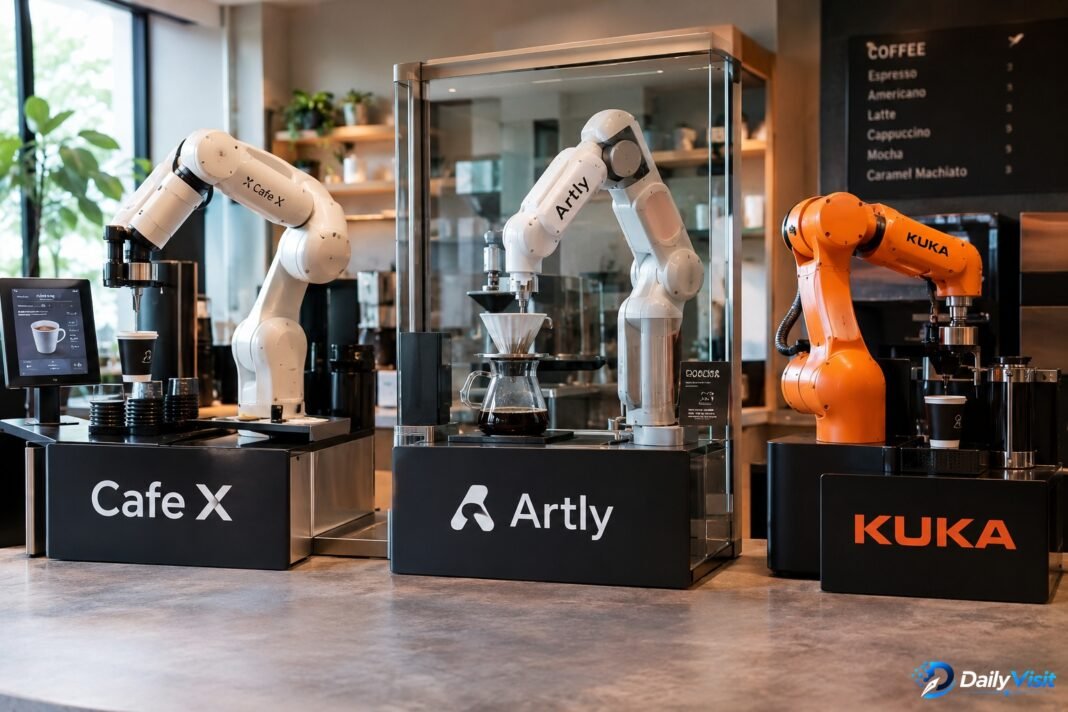

Coffee Robot Brands Cafe X Artly Rozum KUKA Competitors! Cafe X, Artly, Rozum, and KUKA all use robotic arms to prepare coffee, but they serve different needs. Cafe X offers a fully automated retail kiosk built for high foot-traffic locations. Artly focuses on barista-style customization and machine learning-driven quality control. Rozum provides collaborative robotic arms suited to flexible café layouts. KUKA brings industrial-grade robotics, prioritizing durability and enterprise deployment over café-specific design.
Robotic arms pulling espresso shots used to look like a novelty act. Now they’re showing up in airports, office lobbies, and shopping malls, quietly replacing (or supplementing) human baristas during peak rush hours. The appeal is obvious: robots don’t call in sick, they don’t make inconsistent pours, and they can operate around the clock without a break.
As automation matures, several companies have positioned themselves as leaders in this space—Cafe X, Artly, Rozum, and KUKA among them. Each brand takes a distinct approach to solving the same problem: how to deliver consistent, high-quality coffee without relying entirely on human labor.
For café owners and investors, understanding these differences is not optional. Choosing the wrong system can mean overspending on capabilities you don’t need, or under-investing in a machine that can’t keep pace with demand. This comparison breaks down what each brand offers, how they stack up against one another, and which one might fit your business best.
What Are Coffee Robots?
Coffee robots are automated systems—typically built around robotic arms—that handle some or all of the coffee-making process, from grinding and dosing to steaming milk and finishing a drink. Unlike a standard espresso machine, these systems don’t require a human operator to manage each step.
The core value proposition comes down to three things:
- Consistency: A robotic arm executes the same motion with the same pressure and timing every time, removing the variability that comes from different baristas making the same drink.
- Efficiency: Robots can operate continuously, cutting down on wait times during rush periods and reducing labor costs over time.
- Customer experience: For many customers, watching a robot prepare their drink is part of the appeal—it’s a visible demonstration of quality control and novelty that draws foot traffic.
These systems are most commonly deployed in commercial café environments like airports, malls, corporate campuses, and high-traffic urban kiosks—places where speed and consistency matter as much as flavor.
Cafe X: Features and Capabilities
Cafe X built its reputation on fully automated robotic kiosks designed for retail environments. The system uses a robotic arm housed inside a compact kiosk to grind, brew, and serve coffee with minimal human involvement—typically just one attendant managing multiple kiosks at once.
Technological innovations and barista-quality output
Cafe X kiosks are designed to replicate café-quality espresso drinks using standardized recipes and precision dosing. The robotic arm handles cup placement, brewing, and drink assembly, aiming to match the consistency of a trained barista without the variability.
Pricing, deployment, and user experience considerations
Cafe X kiosks are typically deployed in high-traffic public spaces where footprint and speed matter more than menu breadth. Because the system operates as a self-contained kiosk, deployment tends to be faster than integrating robotics into an existing café layout, though it requires dedicated floor space and ongoing technical support.
Artly: The Robotic Barista Solution
Artly takes a different approach, positioning itself as a robotic barista rather than a vending-style kiosk. The company emphasizes machine learning to monitor and improve drink quality over time, aiming to replicate the nuanced techniques of skilled human baristas.
Design philosophy and operational approach
Artly’s systems are built around the idea that automation should enhance, not flatten, the craft of coffee-making. Its robots are designed to execute techniques like latte art and precise milk texturing, appealing to cafés that want to maintain a premium, specialty-coffee image.
Customization options and integration capabilities
Artly’s platform supports a broader range of menu customization compared to simpler vending-style robots, making it a better fit for cafés that want to offer specialty drinks rather than a standardized menu.
Performance metrics and real-world implementations
Artly has focused deployments in retail and hospitality settings where brand experience matters as much as throughput, using its systems as a visible differentiator rather than a purely back-of-house efficiency tool.
Rozum: Advanced Automation Technology
Rozum Robotics built its name on collaborative robotic arms—service robots designed to work safely alongside humans rather than replace them entirely.
Technical specifications and precision capabilities
Rozum’s robotic arms are engineered for precise, repeatable movements, which translates well to tasks like consistent pouring and ingredient dosing. Their collaborative design also includes safety features that allow the robots to operate near customers and staff without extensive barriers.
Scalability and adaptability for different café environments
Because Rozum’s robots aren’t built as an all-in-one kiosk, they offer more flexibility for cafés that want to integrate automation into an existing layout rather than replacing it entirely with a self-contained unit.
KUKA: Industrial-Grade Coffee Automation
KUKA is not a coffee-specific company. It’s a long-established industrial robotics manufacturer that has extended its robotic arm technology into food and beverage automation, including coffee-making demonstrations and installations.
Background and transition into café robotics
KUKA’s core business is industrial automation—automotive manufacturing, logistics, and heavy-duty robotics. Its entry into coffee automation leverages that industrial-grade engineering rather than starting from a café-first design philosophy.
Robustness, reliability, and long-term durability
This industrial pedigree is KUKA’s biggest differentiator. Its robotic arms are built for continuous, high-cycle operation in demanding environments, which can translate into strong long-term durability for coffee applications.
Enterprise-level solutions and support systems
KUKA typically serves larger enterprise clients rather than independent café owners, offering the kind of technical support and integration services associated with industrial equipment providers.
Comparison Table
|
Feature |
Cafe X |
Artly |
Rozum |
KUKA |
|---|---|---|---|---|
|
Primary format |
Self-contained kiosk |
Robotic barista system |
Collaborative robotic arm |
Industrial robotic arm |
|
Best suited for |
High-traffic retail spaces |
Specialty coffee experiences |
Flexible café integration |
Enterprise-scale operations |
|
Customization level |
Moderate |
High |
Moderate to high |
Depends on integration |
|
Human-robot collaboration |
Minimal (attendant only) |
Moderate |
High (collaborative design) |
Low to moderate |
|
Deployment complexity |
Low to moderate |
Moderate |
Moderate |
Higher (enterprise integration) |
|
Core strength |
Speed and consistency |
Craft and brand experience |
Adaptability and safety |
Durability and reliability |
Pricing and ROI Analysis
Exact pricing for each of these systems varies significantly based on configuration, location, and service agreements, and none of the companies publish standardized rate cards. That said, a few general principles apply across the category.
Initial investment costs
Kiosk-style systems like Cafe X typically involve a packaged cost that includes the hardware, software, and kiosk enclosure. Robotic arm-based systems like those from Rozum or KUKA often require additional integration costs—custom enclosures, plumbing, and workflow design—since they aren’t sold as turnkey café units.
Long-term operational savings
The primary ROI driver across all four brands is labor cost reduction, particularly in high-traffic locations where a robot can operate continuously without the overtime, turnover, and training costs associated with human staff. Consistency also reduces waste from inconsistent pours or recipe errors.
Hidden costs and maintenance considerations
Café owners should factor in ongoing maintenance contracts, software updates, and potential downtime during repairs. Industrial-grade systems like KUKA’s may have longer service intervals due to their build quality, while more café-specific systems may require more frequent calibration to maintain drink consistency.
Which Coffee Robot Brand Is Right for You?
- Choose Cafe X if your priority is a fast, self-contained deployment in a high-traffic retail environment where speed matters more than menu depth.
- Choose Artly if you’re running a specialty coffee concept and want automation that preserves the craft and visual appeal of a skilled barista.
- Choose Rozum if you need a flexible, collaborative system that can be integrated into an existing café layout alongside human staff.
- Choose KUKA if you’re operating at enterprise scale and need industrial-grade durability with long-term reliability over café-specific design features.
Looking ahead, the coffee robotics category will likely keep splitting into these two lanes: consumer-facing novelty and experience (Cafe X, Artly) versus back-end industrial efficiency (Rozum, KUKA). Café owners should think about which lane matches their brand positioning before making a purchase decision.
Frequently Asked Questions
Q1. How much does a coffee robot typically cost to install?
Costs vary widely depending on the brand, configuration, and whether the system is a self-contained kiosk or requires custom integration. None of the major brands publish fixed public pricing, so café owners should request custom quotes based on their specific location and volume needs.
Q2. Are coffee robots reliable enough for high-volume cafés?
Yes, particularly industrial-grade systems like KUKA’s, which are built for continuous, high-cycle operation. However, reliability also depends on regular maintenance and calibration, regardless of the brand.
Q3. Can coffee robots make specialty drinks, not just basic espresso?
It depends on the brand. Artly is specifically designed to support more advanced techniques and menu customization, while kiosk-style systems like Cafe X tend to focus on a more standardized menu.
Q4. What’s the biggest risk of investing in a coffee robot?
The biggest risks are choosing a system that doesn’t match your actual volume needs and underestimating ongoing maintenance costs. A high-capacity industrial system may be overkill for a small independent café, while a simple kiosk may not scale for enterprise deployment.
Q5. Are there alternatives to full robotic coffee systems?
Yes. Many cafés opt for partial automation—such as automated grinders or dosing systems—rather than a full robotic arm setup, which can reduce costs while still improving consistency.
ALSO READ : GizmoCrunch: Latest Tech News, Gadgets, Reviews and Digital Trends
The Future of Automated Coffee Service
Robotic coffee systems aren’t replacing human baristas overnight, but they are reshaping how cafés think about speed, consistency, and labor costs. The broader robotics industry growth also shows how service automation is expanding beyond traditional industrial applications.
The right choice depends less on which brand is “best” and more on what your café actually needs: foot traffic and speed, specialty drink quality, integration flexibility, or long-term durability. Before committing, request a live demo from your top candidates and ask directly about maintenance schedules, support response times, and total cost of ownership over a multi-year period.