
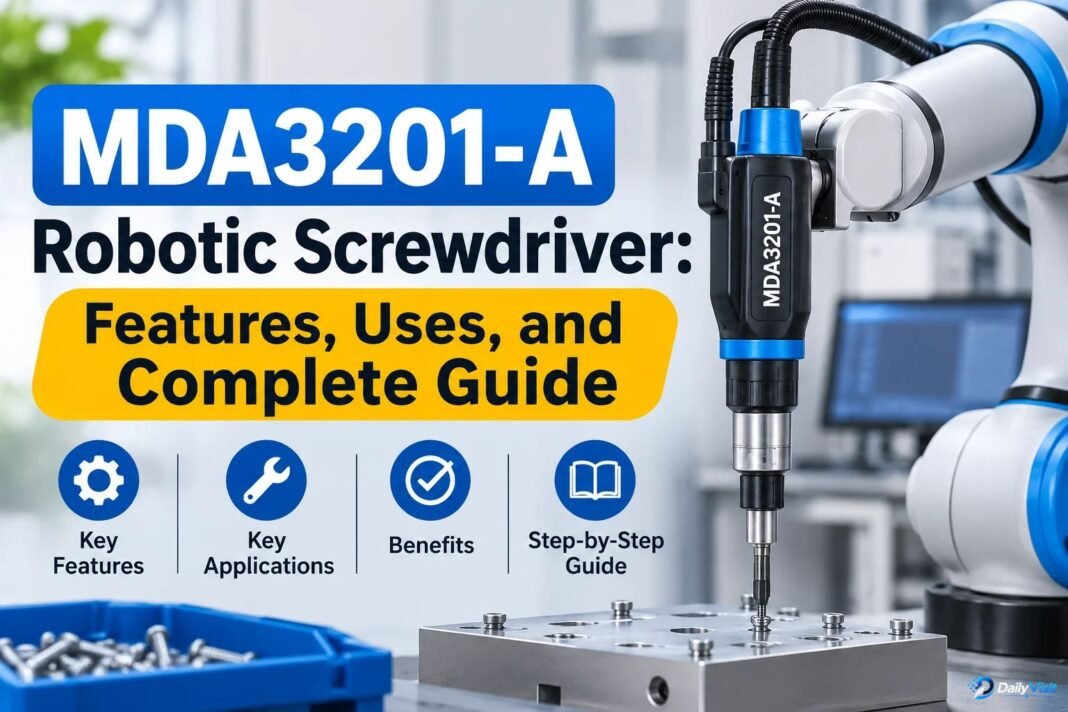

The MDA3201-A robotic screwdriver is an automated fastening tool designed for precision-driven manufacturing environments. It combines programmable torque control, interchangeable bit compatibility, and built-in error detection to reduce assembly defects and labor costs. Manufacturers in electronics, automotive, medical device, and aerospace sectors use the MDA3201-A to standardize fastening quality across high-volume production lines.
Precision fastening used to be a bottleneck. A single over-torqued screw could crack a circuit board, strip a housing, or trigger a costly recall. Manual screwdriving, no matter how skilled the operator, introduces variability that quality control teams spend hours chasing down.
The MDA3201-A robotic screwdriver was built to close that gap. Instead of relying on human consistency alone, this tool applies programmable torque settings and automated feedback loops to every single fastening cycle, whether it’s cycle one or cycle ten thousand.
This guide walks through what the MDA3201-A actually is, how it works, where it fits into modern production lines, and how it stacks up against the broader robotic fastening market. By the end, you’ll understand whether this tool matches your production needs and what to expect from implementation, maintenance, and long-term return on investment.
What Is the MDA3201-A Robotic Screwdriver?
The MDA3201-A is an automated robotic fastening system engineered for repetitive, high-precision screwdriving tasks on production lines. Unlike a handheld electric screwdriver, the MDA3201-A integrates into automated assembly cells, working alongside conveyor systems, robotic arms, and vision-guided positioning equipment to deliver consistent torque application without manual intervention.
Design Innovations That Set the MDA3201-A Apart
For additional insights into automated fastening systems, explore Visumatic’s robotic screwdriver solutions, which demonstrate how robotic screwdriving technology supports precision and consistency in industrial assembly.
The MDA3201-A’s core design philosophy centers on closed-loop torque feedback. Rather than applying a fixed rotational force and hoping for the best, the system continuously monitors resistance as the screw seats, adjusting in real time to avoid over-tightening or under-tightening. This closed-loop approach is paired with a modular bit-holder assembly, allowing operators to switch between screw types without recalibrating the entire unit.
MDA3201-A vs. Traditional Screwdrivers and Other Automated Tools
Traditional pneumatic or electric screwdrivers rely heavily on operator technique. Even well-trained technicians introduce small variances in angle, pressure, and timing across a shift. The MDA3201-A removes that variable entirely by executing identical motion profiles on every cycle.
Compared to other automated screwdriving solutions, the MDA3201-A distinguishes itself through its emphasis on adaptability. Many automated fastening tools are built for a single screw type or a narrow production use case. The MDA3201-A’s modular design means a single unit can often support multiple product lines, reducing the need to purchase separate equipment for each assembly variant.
Core Features and Specifications
Choose the MDA3201-A if your production environment demands tight tolerances, screw-type flexibility, and built-in quality assurance. For operations with lower precision requirements or very low production volumes, a simpler electric screwdriver may offer a more cost-effective fit.
Precision Torque Control and Adjustment
Torque precision is the MDA3201-A’s defining feature. Operators can program target torque ranges for specific assemblies, and the system’s feedback sensors confirm that each fastener lands within tolerance before releasing the next cycle. This matters most in industries where over-torquing risks structural damage or under-torquing risks loosening over time.
Speed and Efficiency Metrics
Because the MDA3201-A automates both the driving motion and the quality check in a single cycle, it eliminates the secondary inspection step many manual lines require. This integrated approach shortens overall cycle time compared to manual fastening followed by separate torque verification.
Compatibility With Various Screw Types and Sizes
The modular bit-holder system accommodates a range of screw head types and sizes, which reduces changeover downtime when a production line shifts between product variants. This flexibility is particularly valuable for contract manufacturers handling multiple client products on the same line.
Build Quality and Durability
Built for continuous industrial use, the MDA3201-A is constructed to withstand the vibration, dust, and repetitive motion stress typical of high-volume assembly environments. Durable construction reduces unplanned downtime from component wear, which directly protects production throughput.
Safety Features and Error Detection
The MDA3201-A includes built-in error detection that flags failed fastening attempts, stripped screws, or torque readings outside the programmed range. This gives quality control teams an automatic audit trail instead of relying solely on end-of-line inspection, and it reduces the risk of defective units reaching the next stage of assembly.
Primary Uses and Applications
Manufacturing and Assembly Line Operations
The MDA3201-A fits naturally into general manufacturing assembly lines where repetitive fastening tasks make up a significant portion of labor hours. Automating these tasks frees skilled workers to focus on tasks that require human judgment, such as final inspection or complex sub-assembly work.
Electronics and Consumer Goods Production
Choose the MDA3201-A for electronics assembly if torque sensitivity matters more than raw speed. Circuit boards, device housings, and small consumer electronics often require tightly controlled torque to avoid cracking delicate components, making precision control a higher priority than maximum cycle speed.
Automotive Industry Applications
Automotive assembly involves thousands of fasteners per vehicle, many of which carry safety implications. The MDA3201-A’s consistency supports compliance with strict quality standards common in automotive manufacturing, where a single missed torque specification can trigger a line-wide quality hold.
Medical Device Assembly Requirements
Medical device manufacturing often operates under regulatory scrutiny that demands documented, repeatable processes. The MDA3201-A’s built-in error logging supports traceability requirements, giving manufacturers a digital record of torque data for each unit produced.
Aerospace and Defense Sector Uses
Aerospace fastening tolerances are famously unforgiving. Components assembled with the MDA3201-A benefit from programmable torque consistency that helps manufacturers meet the stringent tolerance requirements common in aerospace and defense contracts.
Benefits and Advantages
Increased Productivity and Reduced Labor Costs
Automating repetitive fastening tasks reduces the direct labor hours required per unit, freeing staff for higher-value work elsewhere on the line.
Consistent Quality and Reduced Defect Rates
Because the MDA3201-A applies identical torque profiles on every cycle, manufacturers typically see fewer fastening-related defects compared to manual processes, which directly reduces rework and scrap costs.
Worker Safety and Ergonomic Improvements
Repetitive manual screwdriving is a known contributor to repetitive strain injuries. Shifting this task to an automated tool reduces physical strain on workers and can lower workplace injury rates tied to repetitive motion.
Long-Term Cost Savings and ROI Potential
While the upfront investment in robotic fastening equipment is higher than purchasing a handheld tool, the combination of reduced defect rates, lower rework costs, and reduced labor hours typically builds toward a favorable return on investment over the equipment’s operational lifespan.
Scalability for Different Production Volumes
The MDA3201-A’s programmable settings mean the same unit can be reconfigured for different products as production needs shift, supporting manufacturers who need flexibility across varying order volumes.
How to Operate the MDA3201-A
Initial Setup and Calibration Procedures
Before first use, the MDA3201-A requires calibration against the specific screw type, material, and target torque range for the assembly job. This step establishes the baseline the system will use for its closed-loop feedback during production.
Step-by-Step Operation Guidelines
- Load the appropriate bit attachment for the screw type in use.
- Program the target torque range and cycle count for the production run.
- Position the workpiece according to the line’s established fixturing.
- Initiate the cycle and monitor the system’s feedback display for flagged errors.
- Review logged torque data at scheduled intervals to confirm consistency.
Maintenance and Cleaning Best Practices
Regular maintenance helps the MDA3201-A maintain its precision over time. This includes cleaning dust and debris from the bit-holder assembly, checking sensor calibration on a scheduled basis, and inspecting moving components for wear.
Troubleshooting Common Issues
Common issues include misaligned bit attachments, sensor drift that affects torque accuracy, and software errors tied to outdated firmware. Most manufacturers resolve these through routine recalibration or firmware updates rather than hardware replacement.
Safety Protocols and Best Practices
Operators should follow lockout-tagout procedures during maintenance, ensure guarding is in place during operation, and confirm that error detection alerts are actively monitored rather than overridden.
Comparing the MDA3201-A to Competitors
Performance Comparison With Similar Models
You can also explore OnRobot’s robotic assembly applications to understand how robotic automation improves fastening processes, assembly efficiency, and manufacturing flexibility.
Choose the MDA3201-A if screw-type flexibility and integrated error detection matter more to your operation than having the single fastest cycle time available on the market. Its modular design trades some specialization for broader applicability across product lines.
Price-to-Value Analysis
For manufacturers running multiple product variants on a shared line, the MDA3201-A’s flexibility can offset its upfront cost by reducing the need for multiple specialized machines.
Customer Satisfaction and Reliability Ratings
Manufacturers evaluating any robotic fastening tool should request reliability data and customer references directly from the supplier, since real-world performance can vary based on production environment and maintenance practices.
Industry Certifications and Standards Compliance
Before purchasing, confirm the MDA3201-A’s current certifications against the specific industry standards relevant to your sector, as compliance requirements vary across electronics, automotive, medical, and aerospace manufacturing.
For further reading on industrial fastening standards and quality benchmarks, see the International Organization for Standardization’s guidance on assembly tolerances (link) and the Occupational Safety and Health Administration’s resources on ergonomic risk reduction in manufacturing (link).
The Future of Robotic Fastening Technology
The MDA3201-A reflects a broader shift in manufacturing toward tools that combine precision, flexibility, and built-in quality assurance. As production lines continue to demand faster changeovers and tighter tolerances, robotic fastening systems that can adapt across multiple screw types and product variants will likely become the standard rather than the exception.
For manufacturers weighing an investment in the MDA3201-A, the decision ultimately comes down to production volume, tolerance requirements, and how much value flexibility holds within your specific line. Industries with strict torque requirements, like medical devices and aerospace, stand to gain the most immediate benefit. Operations with lower-precision needs may find a simpler automated tool sufficient.
Before committing, request a site evaluation from the manufacturer to confirm the MDA3201-A integrates smoothly with your existing production equipment and quality control processes.
ALSO READ : Coffee Robot Brands Cafe X Artly Rozum KUKA Competitors Compared
Frequently Asked Questions
Q1. How much does the MDA3201-A robotic screwdriver cost?
Pricing varies based on configuration, bit attachments, and integration requirements. Manufacturers should request a formal quote directly from the supplier based on their specific production line needs.
Q2. How long does it take to implement the MDA3201-A on an existing line?
Implementation timelines depend on how much the existing line needs to be reconfigured. Simple integrations may take a few days, while lines requiring significant retooling can take several weeks.
Q3. What are the risks of switching to the MDA3201-A from manual screwdriving?
The primary risks involve upfront calibration time and potential short-term production slowdowns during the transition. These risks are typically offset by long-term gains in consistency and reduced defect rates.
Q4. Are there alternatives to the MDA3201-A?
Yes. Several automated fastening systems exist on the market, varying in torque range, screw-type compatibility, and price point. Manufacturers should compare options based on their specific tolerance requirements and production volume.
Q5. Who is the MDA3201-A best suited for?
The MDA3201-A is best suited for manufacturers in electronics, automotive, medical device, and aerospace sectors who need consistent torque control across high fastener volumes and benefit from flexibility across multiple screw types.